The Canadian Government just released new fishing rules, regulations and conservation measures for Northern and Southern BC Chinook salmon in an effort to provide food for southern resident orcas. The map below shows the no fishing zone between the red marks. Effective June 1 to September 30, 2018 there is no fishing for finfish in Subareas 18-2, 18-4, 18-5, 18-9, 19-1 to 19-4 and Area 20. Map below shows Area 20 sub areas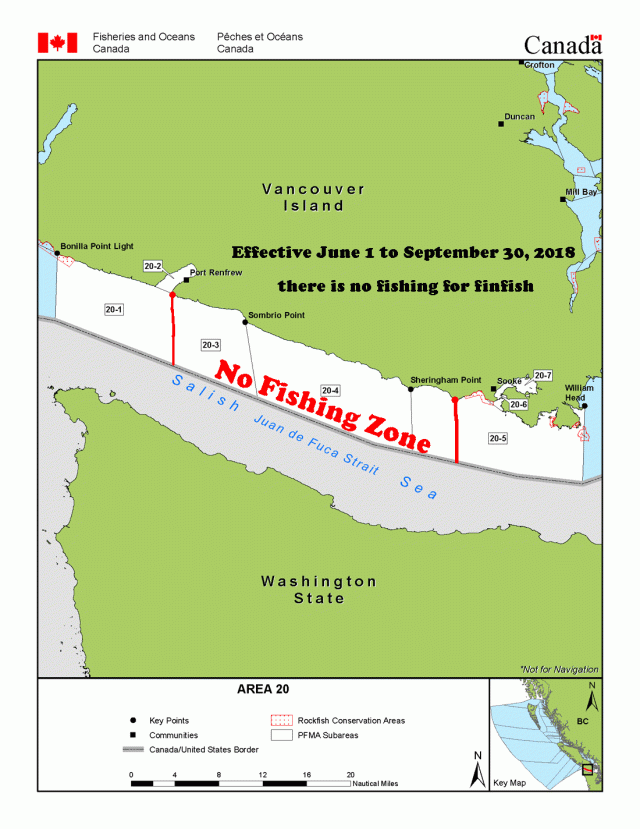 Juan de Fuca (Subareas 19-1 to 19-4 and Area 20): Effective June 1, 2018 to September 30, 2018 there is no fishing for finfish in Subareas 20-3, 20-4 and that portion of Subarea 20-5 that lies west of 123 degrees 49.30 minutes west longitude (Otter Point) Effective June 1, 2018 until June 28, 2018 the daily limit for Chinook salmon is two (2) per day which may be wild or hatchery marked between 45 and 67 cm fork length or hatchery marked greater than 67 cm in Subareas 19-1 to 19-4 and 20-6 and 20-7 and that portion of Subarea 20-5 that lies east of 123 degrees 49.30 minutes west longitude (Otter Point). Effective June 29, 2018 until July 31, 2018, the daily limit for Chinook salmon is two (2) Chinook per day which may be wild or hatchery marked between 45 and 85 cm or hatchery marked greater than 85 cm in Subareas 19-1 to 19-4 and 20-6 and 20-7 and that portion of Subarea 20-5 that lies east of 123 degrees 49.30 minutes west longitude (Otter Point).
Notes: Additional local closures may be in effect in your area. Please check for the latest closures and restrictions for your area, and other recreational fishing information at: www.pac.dfo-mpo.gc.ca/recfish Further information on specific management actions by area may be communicated by separate Fishery Notices. You can view or subscribe to fisheries notices at: http://notices.dfo-mpo.gc.ca/fns-sap/index-eng.cfm www.pac.dfo-mpo.gc.ca/recfish FOR MORE INFORMATION: Contact your local DFO officehttp://www.dfo-mpo.gc.ca/contact/regions/pacific-pacifique-eng.html
Fishery Notice – Fisheries and Oceans Canada Subject: FN0428-Conservation Measures for Northern and Southern BC Chinook Salmon and Southern Resident Killer Whales This notice provides information on planned conservation measures for Northern and Southern BC Chinook Salmon and Southern Resident Killer Whales that will be implemented beginning June 1, 2018. Chinook Conservation MeasuresTo address Chinook conservation concerns, DFO is implementing a precautionary 25-35% reduction in exploitation rates for Chinook stocks of concern to support conservation and promote rebuilding. These additional reductions are planned to address conservation concerns for Nass River, Skeena River and many small wild Chinook populations in Northern BC; and, all Fraser River Chinook populations (including Spring 4(2), Spring 5(2), Summer 5(2), Summer 4(1) and Fall 4(1) populations) in Southern BC. Additional Northern BC Chinook management measures are outlined below, followed by additional Southern BC Chinook management measures.
Northern Commercial Fisheries Area F Troll – opening of AABM Chinook fishery delay to July 10 in addition to boundary changes. Refer to the subsequent Fishery Notice for details. Northern Recreational Fisheries Please note that possession limits for Chinook Salmon are twice the daily limit. The recreational daily limits of Chinook Salmon are being reduced in North Coast tidal waters as follows: Haida Gwaii: Effective June 1, 2018 to July 9, 2018, the daily limit is one (1) Chinook per day in Areas 1, 2, 142, and that portion of Area 101 west of 131 degrees 40.0 minutes West longitude North Coast: Effective June 1, 2018 to June 15, 2018, the daily limit is one (1) Chinook per day in Areas 3 to 5, 103 to 105, Subarea 102-1, and that portion of Area 101 east of 131 degrees 40.0 minutes West longitude
Effective June 16, 2018 to July 9, 2018, there is zero (0) retention of Chinook Salmon in Areas 3 to 5, 103 to 105, Subarea 102-1, and that portion of Area 101 east of 131 degrees 40.0 minutes West longitude Effective July 10, 2018 to July 31, 2018, the daily limit is one (1) Chinook per day in Areas 3 to 5, 103 to 105, Subarea 102-1, and that portion of Area 101 east of 131 degrees 40.0 minutes West longitude Effective June 1, 2018 to July 31, 2018 the daily limit is one (1) Chinook per day in Areas 6 and 106 Variation Order Number: 2018-RFQ-0307 Management measures for northern BC non-tidal waters were previously announced in FN0372 issued May 8, 2018. Southern BC Commercial Fisheries Area G Troll: There is no commercial fishery for AABM Chinook in June or July. Area B Seine and Area H Troll:Effective June 1 to September 30, 2018, there is no commercial salmon fishing in Subareas 20-3, 20-4 and that portion of Subarea 20-5 that lies west of 123 degrees 49.30 minutes west longitude (Otter Point). Area B Seine and Area H Troll:Effective June 1 to September 30, 2018 there is no commercial salmon fishing in Subareas 18-2, 18-4, 18-5 and 18-9.
Southern BC Recreational Fisheries:
Southern BC Inside Waters Areas 13 to 18, 28 and 29 and Subareas 19-1 to 19-6 (except those portions listed below): Effective June 1, 2018 until September 30, 2018, the daily limit for Chinook Salmon is one (1) per day in in Areas 13 to 17, 28 and 29 with the exception of those four areas listed below under the headings Strait of Georgia, Pender Island, Juan de Fuca and Fraser River mouth. Terminal fishing opportunities at full limits for Chinook may be considered in-season if abundance permits. Effective October 1, 2018 until further notice, the daily limit for Chinook Salmon is two (2) per day in in Areas 13 to 19, 28 and 29
Exceptions: Strait of Georgia: Note: this measure came into effect on May 7, 2018 as previously announced in FN0370 issued May 7, 2018. Effective immediately until June 28, 2018 the daily limit for Chinook salmon is two (2) per day, of which only one may be greater than 67 cm in Subareas 18-1, 18-3, 18-6, 18-11, and 19-5. Effective June 29, 2018 to July 31, 2018 the daily limit is two (2) Chinook salmon per day between both of which must be less than 85 cm in Subareas 18-1, 18-3, 18-6, 18-11, and 19-5. Chinook salmon retained in these waters must have a fork length of at least 62 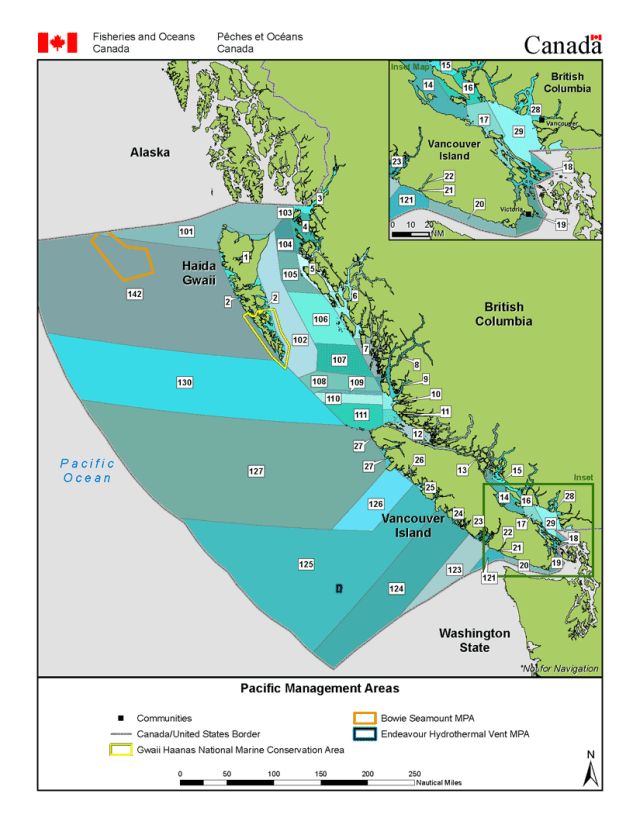

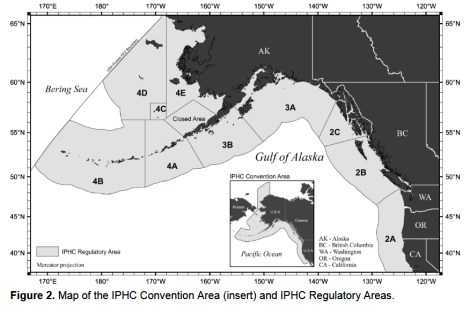 During today’s IPHC Conference Board meeting the Trawl fleet from Areas 4A, B, C, D & E explained their efforts to reduce bycatch on their 19 vessels. They told of deck sorting and other methods to reduce mortality rates. After the presentation they took questions from the Conference Board. My question was simple, would they keep their vessels out of the IPHC closed zone in Area 4E. This area was created in the 1970s because it is a halibut nursery filled with juvenile halibut that weigh 4 to 6 pounds. No user group within the International Pacific Halibut Commission authority can fish in this zone. The zone was put into place as a conservation measure and for the future of halibut stocks.
 Area 2A is unique within the International Pacific Halibut Commission area because of the 13 Treaty Tribes that have fishing rights through Treaties and backed by court rulings. The


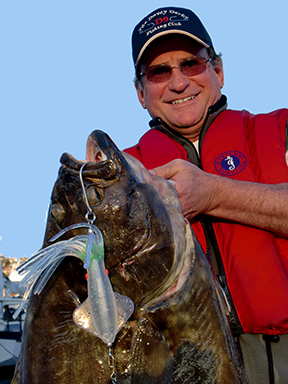 Marine areas 3-10 to re-open for halibut fishing;
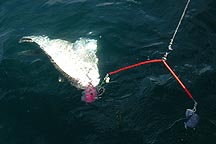 Fish checkers counted 24 halibut Friday, May 25th for the Strait of Juan de Fuca Areas 5, 6, 7, 8, & 9. That’s the “Puget Sound Inside” waters halibut fishery. Weather was less than desirable and down right miserable. Many halibut anglers, including me, opted to stay ashore and not fight wind, waves and currents. I spoke with several anglers that did go halibut fishing and they reported four foot seas which made it difficult to anchor or drift.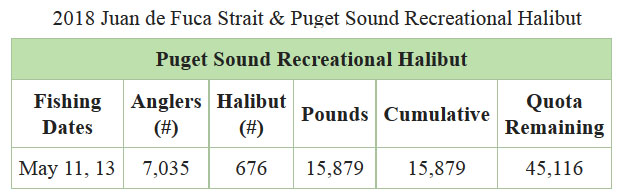
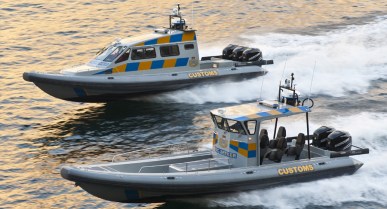 Today a friend decided to go fishing at Coyote Bank, aka “Border Bank” in Canadian waters. Upon calling into Canadian Customs because they were planning to anchor, the Custom’s agent on the phone told them they would have to report to either Victoria or Sydney for inspection, even though they had their Nexus cards and all paperwork in order.
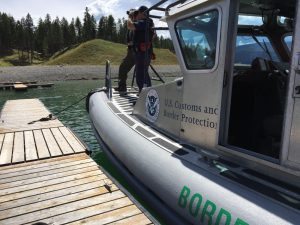 Today the U.S. Customs & Border Patrol boat, with three BIG outboards fueled up at John Wayne Marina, so obviously both sides of the border are watching. Just not sure what is going on with Canadian side of border.



 SquidPro Tackle's Halibut Fishing Chronicles